
xera Architecture
For the full specs see design docs (v0.1 core, v0.2 eval, v0.3 prompt injection, v0.5 self-heal, v0.6 project knowledge graph, v0.7 http-adapter, v0.8 coverage-gap, v0.18 feature-from-openapi, v0.19 contract-drift-web-and-heal; v0.9 adversarial-explore is shipped without a published spec). This is a shorter overview for developers contributing to xera itself.
Layers
End user (QA)
  │ uses `npx xera init --shape web|api|mixed --tracker jira|github` once
  │ (scaffolds CI workflow + npm scripts + per-editor skill paths)
  │ then `/xera-*` slash commands in their AI coding agent (Claude Code, Cursor, or Codex CLI)
  ▼
Skills — 12 user-facing workflows (Claude Code / Cursor / OpenAI Codex CLI via the editor adapter registry in `packages/cli/src/editors/`)
  │ tell the session LLM what to do
  │ session LLM calls `npx xera-internal`
  ▼
`xera-internal` binary (in @xera-ai/core) — 36 subcommands
  │ deterministic helpers + graph data layer + coverage engine
  │ writes artifacts to .xera/<TICKET>/
  │ writes events to .xera/graph/events/
  ▼
Adapters (dispatched by `meta.json.adapter`):
  • @xera-ai/web   — Playwright browser adapter (`--grep` per-scenario filter)
  • @xera-ai/http  — Playwright APIRequestContext adapter (no browser, OpenAPI-aware)
  │ generator helpers (validate, typecheck, lint)
  │ executor + trace normalizer + secret scrubber
  ▼
Playwright + the user's app / HTTP API under test
Editor skill paths
xera init scaffolds skills and commands for each supported editor:
| Editor | Skill path | Command path |
|---|---|---|
| Claude Code | .claude/skills/<n>/SKILL.md | .claude/commands/<n>.md |
| Cursor | .cursor/rules/<n>/RULE.md | .cursor/commands/<n>.md |
| Codex CLI | .agents/skills/<n>/SKILL.md | (no project-level slash) |
v0.6 addition: Project Knowledge Graph
See it live
A real graph rendered from the xera-sample-app-tests project (xera testing FlowBoard) is hosted at xera-ai.github.io/xera-sample-app-tests — click the Map / List / Trend tabs and the Coverage view to see exactly what the binary output of graph-render looks like.
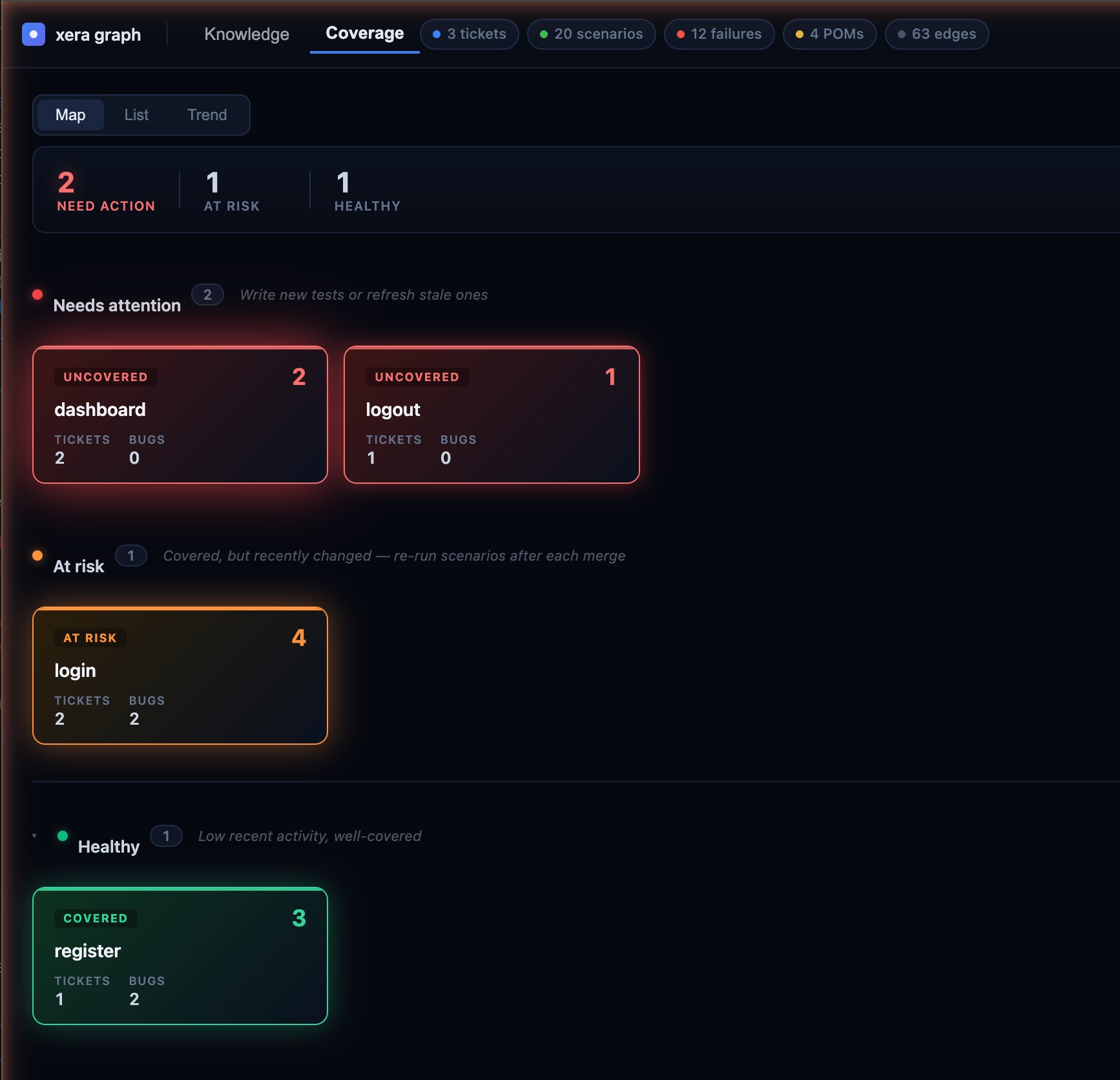
A repo-local event-sourced data layer running parallel to the v0.1 artifact pipeline. Skills emit events on every fetch/script/exec/report/promote. The derived snapshot powers several read-only consumers — classify, impact, coverage (added in v0.8), render, and disputes:
   xera-fetch ──┐
   xera-script ─┤    events.jsonl (append-only, committed)
   xera-exec ───┼──► snapshot.json (gitignored, derived)
   xera-report ─┤
   xera-promote ┘
                          │
                          ▼
          ┌──────────────────────────────┐
          │  Consumers (read-only):      │
          │  • classify (TEST_OUTDATED)  │  → /xera-report 9-class
          │  • impact (riskScore + BFS)  │  → /xera-impact
          │  • coverage (3-state areas)  │  → /xera-coverage + /xera-fill-gap
          │  • render (vis-network HTML) │  → CI artifact + sticky comment
          │  • disputes (CLI report)     │  → QA-lead weekly review
          └──────────────────────────────┘
Key invariants
- The public CLI exposes
init,doctor, andsamples remove. Everything else is via skills. - Skill prompts +
xera-internalform a closed pair: the skill knows when to call which subcommand and what to do with its output. - Every
xera-internalsubcommand reads from disk and writes to disk. No subcommand keeps state across invocations. - AI work happens in the QA's coding-agent session — there is no AI binary shell-out from
xera-internal. Even the graph similarity / TEST_OUTDATED classifier calls the LLM from the skill (skill writes input JSON, calls binary, binary reads input). - Secret scrubbing is deterministic and runs before LLM ever sees normalized run data.
- Graph events are sharded one-file-per-skill-invocation → zero git merge conflicts when multiple QA work in parallel.
Packages
| Package | Responsibility | Public bin |
|---|---|---|
@xera-ai/core | Config, paths, hashing, lock, log, IssueProvider (jira + github backends behind a unified interface, v0.16+), classifier (9 classes: REAL_BUG, CONTRACT_DRIFT, AUTH_EXPIRED, RATE_LIMITED, TEST_OUTDATED, TEST_BUG, SELECTOR_DRIFT, FLAKY, PASS), auth state (AES-256-GCM), shared scrub rules (relocated from web in v0.7), graph module (types, schema, store, similarity, enrich, classify, traverse, impact, render, cost), coverage module (status, risk, report, why) | xera-internal |
@xera-ai/cli | Public CLI: init (with --shape web|api|mixed, --tracker jira|github, --editor claude|cursor|codex|all), doctor (with --strict [ticket]), samples remove | xera |
@xera-ai/web | Playwright browser adapter (executor with --grep support, trace normalizer, secret scrubber, POM-scan + Gherkin lint) | — |
@xera-ai/http | HTTP API adapter (Playwright APIRequestContext, no browser). Pre-auth via defineHttpAuthSetup + presetHttpAuth; runtime newAuthedContext for generated spec.ts; OpenAPI loader for schema-aware generation + CONTRACT_DRIFT detection; extractOperations flattens a spec for /xera-feature --from-spec (v0.18) | — |
@xera-ai/skills | 12 AI coding-agent skill .md files (xera-run, xera-fetch, xera-feature, xera-script, xera-exec, xera-report, xera-impact, xera-promote, xera-eval, xera-coverage, xera-fill-gap, xera-explore); scaffolded per editor (Claude Code / Cursor / Codex CLI) by xera init; dispatch by meta.json.adapter | — |
@xera-ai/prompts | 14 versioned LLM prompt templates: diagnose-failure, feature-from-story, feature-from-openapi (v0.18), script-from-feature-web, script-from-feature-http, heal-locator, contract-heal (v0.19), extract-areas, similarity-match, classify-outdated, eval-rubric, map-ac-to-scenarios, propose-scenarios, adversarial-scenarios | — |
xera-internal subcommands (36)
Core flow (v0.1+): fetch, validate-feature, typecheck, lint, exec, normalize, report, post, status, unlock, promote
Eval harness (v0.2): eval-prepare, eval-deterministic, eval-report
Self-heal (v0.5): heal-prepare
Project knowledge graph (v0.6):
graph-record <fetch|script|exec|classify|promote|dispute>— emit events from artifactsgraph-snapshot [--check]— derive / verify snapshotgraph-query [--ticket --format]— ASCII or JSON dumpgraph-backfill [--dry-run]— synthesize events from existing artifactsgraph-enrich --ticket <id>— populate similarity edges via Claudegraph-render [--since --ticket --depth --out]— HTML viewerimpact-prepare <TICKET>— risk-scored impact listdisputes [--since --format]— QA dispute report
HTTP adapter (v0.7):
auth-setup [--role <name>] [--shape web|http|all]— pre-authenticate, writes encrypted.xera/.auth/{web,http}/<role>.jsonopenapi-resolve— load + dereference an OpenAPI spec for downstream classifier / generator useexec,normalize,reportextended to dispatch bymeta.json.adapter
Coverage gap (v0.8):
coverage-prepare— reads snapshot, computes per-area status (UNCOVERED/STALE/COVERED), risk scores, and AC gap list; writesreport.jsonac-coverage-backfill-prepare— readsreport.jsonAC gaps; writesbackfill-input.jsonfor skill-sidemap-ac-to-scenarios.mdpromptac-coverage-backfill-finalize— reads skill-writtenbackfill-output.json; validates mappings; emitsac-coverage.backfilledevent; materializessatisfiesedges in the graphfill-gap-prepare— reads snapshot for a given area or ticket; writesfill-gap-input.jsonfor skill-sidepropose-scenarios.mdpromptfill-gap-finalize— reads skill-writtenfill-gap-output.json; writesfeature.draft.mdwith the accepted Gherkin proposals
Adversarial explore (v0.9, experimental):
explore-prepare <TICKET> --categories <slugs> --user-hint <text>— assemblesadversarial-input.jsonfrom story, AC, existing feature/spec, adapter, and QA-supplied focusexplore-finalize <TICKET> --accept <ids|all|high-only>— appends accepted proposals to.xera/<TICKET>/explore.featurewith@adversarialtags
Feature-from-OpenAPI (v0.18):
feature-spec-prepare <KEY> [--spec --tag --operation --path]— loads + flattens an OpenAPI doc (extractOperations), writesspec-input.json+ a syntheticstory.md+meta.json(source: 'openapi') for/xera-feature --from-spec; deterministic, no LLM
CONTRACT_DRIFT self-heal (v0.19):
contract-heal-prepare <TICKET> <RUN_ID> <SCENARIO>— assembles the drifting call + OpenAPI contract (documented statuses + required fields) + thespec.tsassertion line; web adapter short-circuits withweb-no-assertion
Universal: verify-prompts, doctor (with --auto-enrich for CI; --shape-aware HTTP auth file + OpenAPI checks in v0.7; 3 new coverage checks in v0.8; --strict [ticket] accepts optional ticket since v0.16.1 — --strict alone runs strict env-only checks, --strict <TICKET> adds ticket-specific checks. See #149 for the chicken-and-egg root cause).
v0.8 addition: Coverage gap & AC matrix
The coverage gap feature answers "which SUT areas have no passing tests, and which acceptance criteria are unsatisfied?" It builds on the v0.6 graph: every ticket's modifies edges identify the areas it owns; every scenario's run.classified events record pass/fail history.
Three-state area model. Each area in the snapshot is classified as one of:
UNCOVERED— no scenario has ever been linked to this area.STALE— scenarios exist but the most recent passing run is older thancoverage.staleAfterDays(default 30).COVERED— at least one passing run within the staleness window.
Data flow. coverage-prepare is a pure deterministic binary: it reads the snapshot, applies the three-state logic and the risk formula (recent_tickets × critical_boost + recent_bugs), and writes report.json. The /xera-coverage skill reads that file and prints the gap report to the session. With --viewer, the skill instructs graph-render to include a Coverage tab (Map / List / Trend sub-views). When autoSnapshotOnCoverage: true (default), a coverage.snapshot event is emitted, which the Trend sub-view reads over time.
AC backfill flow. When report.json lists unsatisfied ACs, /xera-coverage runs the AC backfill: ac-coverage-backfill-prepare writes backfill-input.json, the skill reads the map-ac-to-scenarios.md prompt and calls the LLM in-session, then ac-coverage-backfill-finalize validates the output and materializes satisfies edges (ACNode → ScenarioNode) in the graph, emitting an ac-coverage.backfilled event.
Generative gap-fill. /xera-fill-gap <area> (area mode) or /xera-fill-gap --ticket <TICKET> (AC mode) invokes fill-gap-prepare, passes the input to the propose-scenarios.md prompt, then writes accepted proposals to feature.draft.md via fill-gap-finalize.
New graph entities: ACNode (one per acceptance-criteria line on a fetched ticket), satisfies edge (ACNode → ScenarioNode), coverage.snapshot event, ac-coverage.backfilled event.
v0.9 addition: Adversarial exploration (experimental)
The /xera-explore skill answers "what could go wrong with this feature that the AC does not mention?" It is opt-in, QA-internal, and not part of /xera-run — /xera-feature continues to produce AC-driven scenarios as before, so PO review of test.feature is undisturbed.
Flow. The skill asks QA two interactive questions: (1) which of 8 adversarial categories to focus on (negative, boundary, state-combination, race, error-recovery, a11y, security-smell, non-functional), and (2) any specific concern as a free-text hint. explore-prepare assembles adversarial-input.json from the ticket's story, AC, existing test.feature, existing spec.ts (if present), adapter, and the chosen categories. The adversarial-scenarios.md prompt generates 5–10 proposals with category + severity (low/medium/high) metadata. QA accepts a subset via all / high-only / comma-separated IDs; explore-finalize appends them to .xera/<TICKET>/explore.feature tagged @adversarial @adversarial-<category> @severity-<level> for selective Playwright runs.
Why a separate feature file. test.feature is AC-aligned and PO-reviewed; explore.feature is QA-brainstormed adversarial coverage. Keeping them separate avoids tripling test runtime silently and lets QA review/merge adversarial scenarios into test.feature on their own cadence. /xera-script still reads only test.feature — QA merges in or runs adversarial scenarios manually until multi-feature spec.ts generation lands.
Status. v0.9.0 ships without golden-eval coverage and without xera.config.ts.explore config knobs — both deferred to follow-up releases. Treat AI output as a brainstorming partner, not a source of truth.
v0.18 addition: Feature-from-OpenAPI
/xera-feature <KEY> --from-spec generates a Gherkin test.feature directly from an OpenAPI document — no fetched Jira/GitHub ticket. It's a mode of the existing skill (not a new skill) and is opt-in (never auto-chained from /xera-run); http-flavored.
Flow. The deterministic feature-spec-prepare subcommand loads the configured http.spec (or --spec), flattens it via extractOperations (sorted, hashable), applies --tag/--operation/--path filters, and writes spec-input.json + a synthetic story.md + meta.json (source: 'openapi', spec_hash). The skill then nonce-wraps spec-input.json (the spec may be remote → untrusted) and follows the new feature-from-openapi.md prompt to emit API-flavored scenarios (one per operation happy-path + per documented error response). Everything downstream — /xera-script → /xera-exec → /xera-report, graph, coverage — is unchanged, because the synthetic ticket has the same artifact shape as a real one.
AGENTS.md scaffolding. Also in this line: xera init (and --update) write a root AGENTS.md orienting any AI agent (Claude Code / Cursor / Codex all read it) only when one is absent — a user-curated file is never overwritten; xera doctor reports its presence.
v0.19 addition: Web CONTRACT_DRIFT detection and self-heal
Detection. Until v0.19, CONTRACT_DRIFT fired only for the http adapter. Web tests now match too: the opt-in xeraNetwork recorder (@xera-ai/web, a no-op unless XERA_NETWORK_LOG is set by xera:exec) captures scrubbed page responses to a network.jsonl sidecar; the normalizer prefers that sidecar and correlates calls per scenario; /xera-report runs each FAIL scenario's calls through the existing classifyContractDrift, filtered to documented endpoints (via findOperation) so page/asset loads never false-positive, and stamps CONTRACT_DRIFT per scenario. Config: a web/mixed project points at OpenAPI via web.spec (or http.spec, resolved by resolveOpenApiSpec).
Self-heal. Parallel to the v0.5 selector heal: when a scenario is CONTRACT_DRIFT, contract-heal-prepare assembles the drifting call + the OpenAPI contract + the spec.ts assertion line; the contract-heal.md prompt (v0.3 nonce-wrapped, strict JSON) proposes a single-line rewrite; the xera-report skill applies it verbatim, re-runs xera:exec, and git adds on pass / reverts on fail (single-heal sentinel shared with the selector heal). Http-focused — a web CONTRACT_DRIFT refuses with web-no-assertion; a real-bug refusal protects against healing a genuine backend break. classifyContractDrift itself is unchanged and still guarded by the v0.7 http golden fixtures.
Extension model
To add a new test adapter (mobile, API, performance, security):
- Create
packages/<adapter>/implementingTestAdapterfrom@xera-ai/core/adapter. - Add the adapter id to
xera.config.ts.adapters. - Write per-adapter generator helpers and a trace normalizer.
- Reuse the classifier framework, status writer, Jira comment builder, graph emission patches, and skills as-is.
The classifier, reporter, and graph layer are adapter-agnostic by design. A new adapter inherits TEST_OUTDATED detection, impact analysis, and the HTML viewer for free.
Test data
| Fixture dir | Used by |
|---|---|
fixtures/sample-app/ | Next.js login+dashboard SUT for e2e tests |
fixtures/mock-jira/ | node:http mock Jira (deterministic tickets) |
fixtures/golden-tickets/ | Classifier rubric fixtures (v0.1) |
fixtures/golden-eval/ | /xera-eval rubric fixtures (v0.2 + EVAL-007 heal + EVAL-008/009 classify-outdated) |
fixtures/golden-graph/ | Snapshot/dedup/corrupt + TEST_OUTDATED scenarios (v0.6) |
fixtures/golden-impact/ | impact-prepare BFS scenarios (v0.6) |
fixtures/golden-coverage/ | coverage engine fixtures — 6 scenarios covering UNCOVERED/STALE/COVERED, risk formula, AC gaps (v0.8) |
fixtures/golden-tickets-http/ | HTTP-adapter classifier fixtures (v0.7) — PASS, REAL_BUG, CONTRACT_DRIFT, RATE_LIMITED, AUTH_EXPIRED |
fixtures/mock-api/ | node:http mock HTTP API + openapi.yaml — target for http-adapter integration tests (v0.7) |